
The World Union Astrographic Service
One of the World Union for Space Policy’s oldest institutions, the World Union Astrographic Service was founded in 2093 as a coordinating body for space exploration, and today is the Solar System’s largest scientific organisation. Many of the most important discoveries in recent history, including the colonisation of Jupiter and Saturn, the discovery of life on Europa, and the first human exploration of the Trans-Neptunian objects, have been by Astrographic Service ships and spacers.
The World Union Astrographic Service falls under the aegis of the Department of Science, a Cabinet-level body of the Union Government. The Astrographic Service is a civilian organisation, but it liaises closely with the Space Patrol Service, sharing information to ensure up-to-date charts and guaranteeing a swift Patrol response to potential natural disasters such as solar flares or potentially-hazardous asteroids. Particularly in the years after the Pirate Crisis, Patrol ships would escort Astrographic Service expeditions, though they generally lack the endurance to escort modern deep space missions, and the Astrographic Service is reluctant to see peaceful scientific expeditions becoming armed.
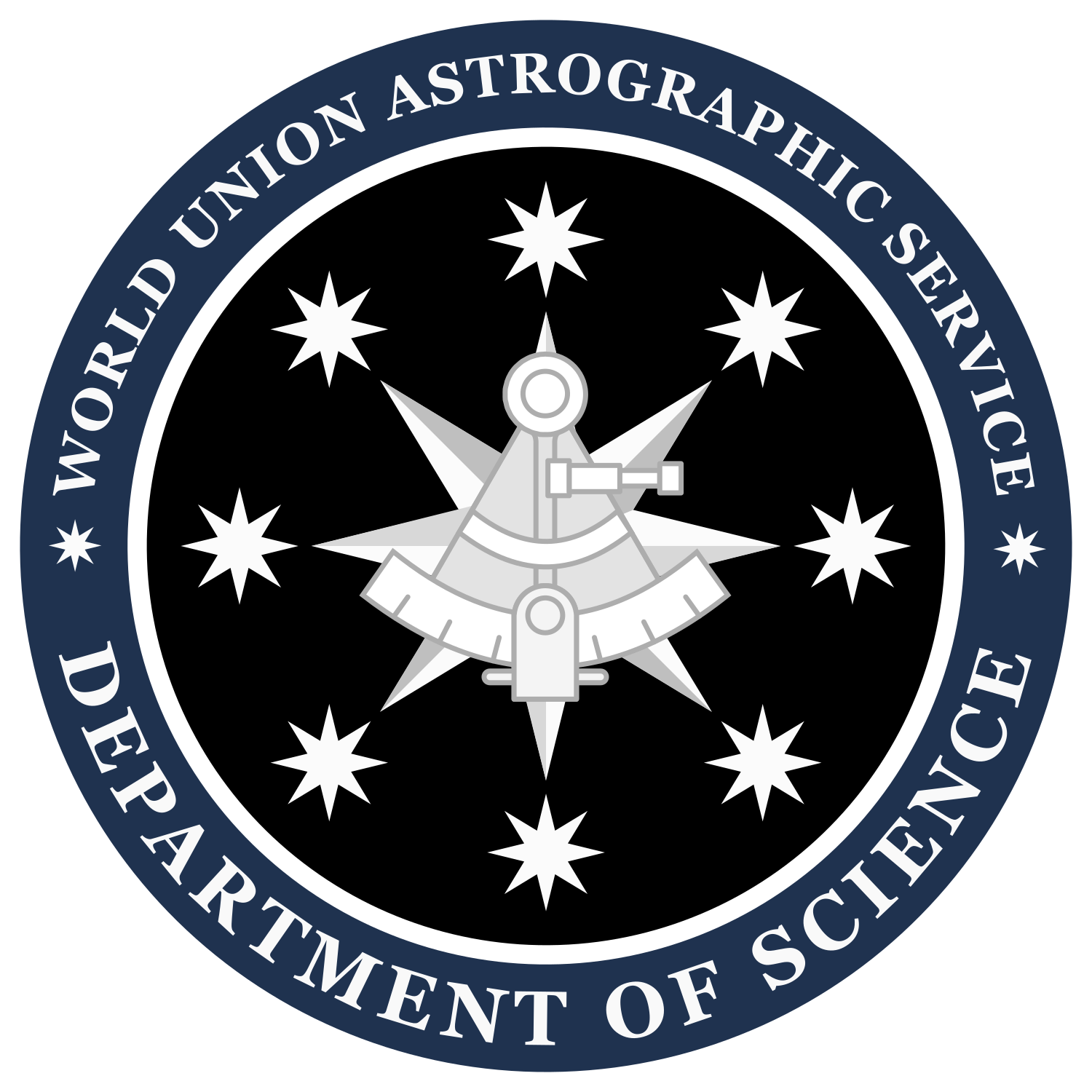
The World Union Astrographic Service’s emblem is a silver sextant combined with the eight-pointed star of the World Union for Space Policy. Astrographic Service ships fly the Blue Ensign of ships in Union Government service, defaced with the sextant-and-star seal. The Astrographic Service is organised into four departments:
Astronomical Operations
Astronomical Operations is responsible for long-range observations of planets, moons, and asteroids to identify likely sites for colonisation or mineral exploitation, prior to direct reconnaissance by Fleet Operations’ survey ships. Astronomical Operations is also responsible for extrasolar observations, maintaining the World Union’s official charts, and tracking potentially-hazardous asteroids and comets.
Astronomical Operations controls a network of survey satellites and long-range space probes for remote exploration. Its personnel work from surface installations such as Luna’s Daedalus Crater Radio Telescope, as well as the Eudoxus-class deep space observation stations. Astronomical Operations personnel also operate aboard the four Helios-class solar observation stations in close orbit of the Sun. These stations are jointly operated with the Space Weather Service, another agency of the Department of Science, for studying the photosphere and providing early warning for solar flares.
Fleet Operations
Fleet Operations conducts manned surveys to confirm colony sites and mineral resources before large-scale settlement begins. A Fleet Operations spacer is often the first human to set foot on a planet, moon, or asteroid. By convention, Fleet Operations’ captains are permitted to name newly-discovered surface features, subject to approval by the Department of Science’s Astronomical Nomenclature Committee.
All of the Astrographic Service’s manned spacecraft fall under Fleet Operations’ control. Its most prominent vessels are the Antilles-class scout ship, the Trinidad-class survey ship, and the Hispaniola-class long-range survey ship. Within Fleet Operations, Station Branch controls the Astrographic Service’s space stations, while Flight Branch controls its aircraft and flitters. This includes the Astrographic Service’s most unique ship, the UAS Caelus, an airship that conducts detailed remote surveys of the surface of Venus. Fleet Operations’ spacegoing vessels carry the prefix “URS” – Union Research Ship.
Fleet Operations is the only uniformed element of the Astrographic Service: spacers wear blue jumpsuits as a working uniform and black trousers with white shirts and shoulder insignia as office wear. For ceremonial occasions, Astrographic Service captains wear a black dress uniform identical in cut to the Space Patrol Service officer uniform, but with gold rank insignia and silver sextant-and-star collar and cap badges. The Commander Fleet Operations holds the unique rank of Commodore and wears a single thick gold sleeve stripe stripe and two rows of gold fretting on their peaked cap.
Surface Survey Operations
The single largest component of the Astrographic Service, Surface Survey Operations provides comprehensive surface mapping once Fleet Operations has completed an initial survey. This includes topographical, geological, and hydrological surveys. Surface Survey Operations’ activities are wildly diverse, covering everything from ice movement on Ganymede and oceanographic studies on Europa, to volcanism on Venus and historic water flows on Mars.
On the World Union’s most established colonies like Luna, Mars, and Ceres, Surface Survey personnel work out of permanent offices in space stations or surface settlements. On more isolated colonies like the moons of Jupiter, Uranus, and Neptune, surveys are conducted out of deployed surface outposts or orbiting space stations. Surface Survey Operations controls the Astrographic Service’s Typhon-class prefabricated surface bases and all of its ground vehicles. Much to the chagrin of Fleet Operations, Surface Survey Operations also maintains control of the seven Sarpedon-class submarines that operate out of Pwyll Base on Europa, exploring the moon’s subsurface ocean.
Since the World Union’s decision to extend colonisation contracts to private companies, beginning with the colonisation of Jupiter, preliminary mapping has been the responsibility of the contracted firm. This practice is almost universally disdained within Surface Survey Operations as producing slapdash and inaccurate work that requires heavy revision.
Ecological and Biological Operations
The smallest element of the World Union Astrographic Service, Ecological and Biological Operations is nevertheless the most essential: it is responsible for planetary protection, preventing the contamination of extraterrestrial biospheres by Earth-origin microorganisms. Biology specialists are assigned to all Fleet Operations ships to maintain planetary protection procedures and study any potential biosignatures. Since the discovery of life in the oceans of Europa, Ecological and Biological Operations has maintained a substantial presence at Pwyll Base, studying the only biosphere known to exist off Earth, and ensuring the rigorous sterilisation of UUVs and submarines to prevent forward and backward contamination.