
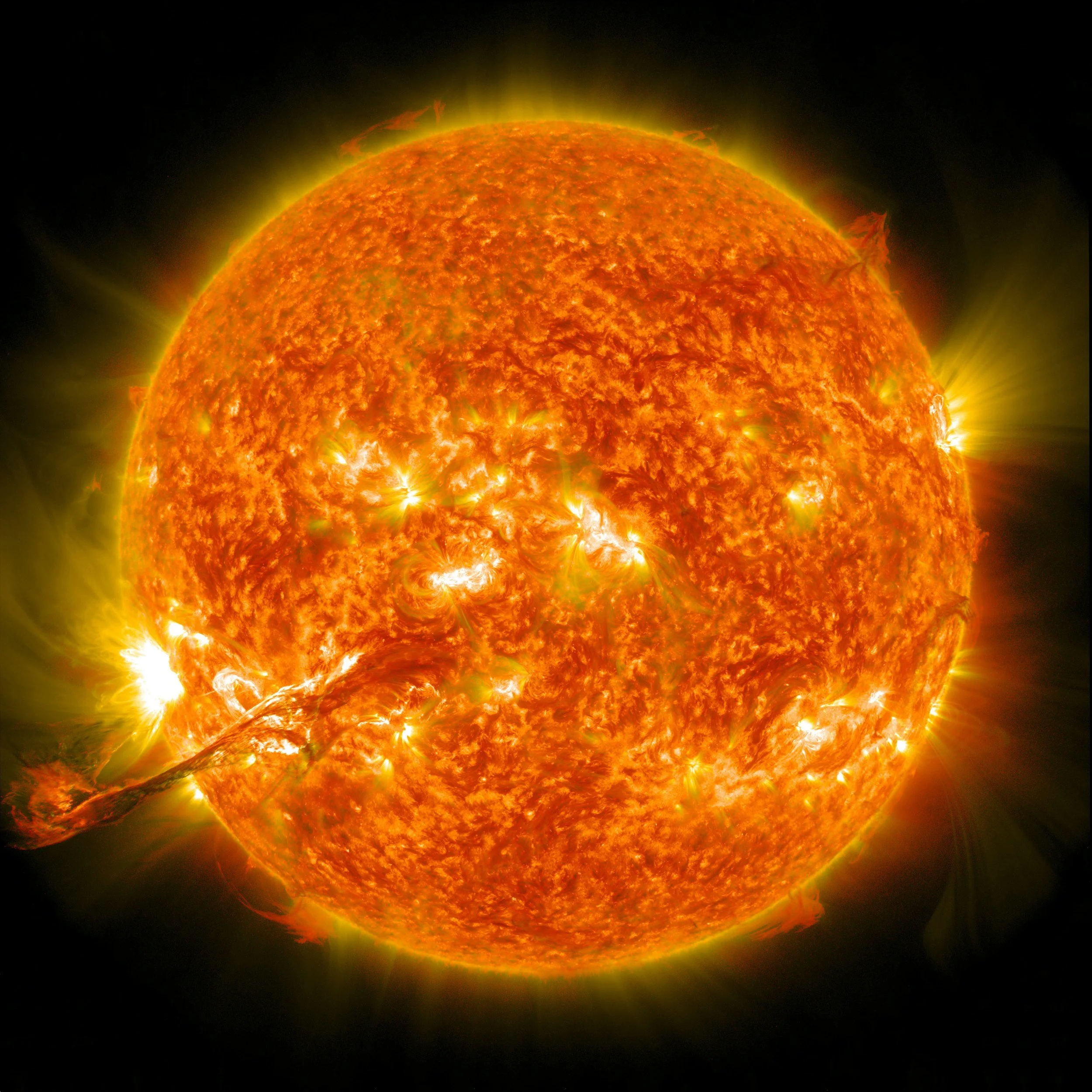
The Solar System
Number of stars: 1
Sun (Sol)
Type: G-type yellow main sequence star
Absolute magnitude: 4.83
Mass: 1 Solar mass
Radius: 695,700 kilometres (1 Solar radii)
Temperature: 5,772 K (5,499 °C)
Age: 4.6 billion years
Planets: 8 (Mercury, Venus, Earth, Mars, Jupiter, Saturn, Uranus, Neptune)
Dwarf planets: 9 (Ceres, Orcus, Pluto, Haumea, Quaoar, Makemake, Gonggong, Eris, Sedna)
Asteroid belts: 1
Formed 4.6 billion years ago by the gravitational collapse of an immense cloud of gas and dust, the Solar System consists of eight planets, nine dwarf planets, and millions of asteroids and comets orbiting around the Sun. It has been extensively colonised since the development of viable fusion torch propulsion in 2093 under the aegis of the World Union for Space Policy. While the vast majority of the human population remains concentrated on Earth, as of 2125 extensive colonies have been established on Luna, Mars, and Ceres. The Asteroid Belt has become the economic engine of the Solar System, providing vast amounts of raw materials for the system’s inner planets. Nascent colonies exist on the moons of Jupiter, and Saturn is expected to be colonised in the next five years to support further expansion into the Outer Solar System.
The Sun itself is orbited by four close observation stations run by the World Union Department of Science, respectively named Clymene, Cycnus, Merope, and Lampetia Stations. These conduct studies of the photosphere and have significantly improved understanding of the Sun’s internal processes. They also provide early warning for changes in the solar wind, sunspot activity, and solar flares, and support exploration of the Vulcanoid asteroids inside Mercury’s orbit. The Sun is also orbited by many hundreds of satellites, probes, and navigation beacons, of which the largest are the eight satellites of the Solar Navigation and Relay System. Positioned in a polar orbit at approximately 7.86 million kilometres from the Sun, between the orbits of Mercury and Venus, these satellites have line-of-sight to virtually every object in the Solar System, making them the most important element of the system’s communications infrastructure.
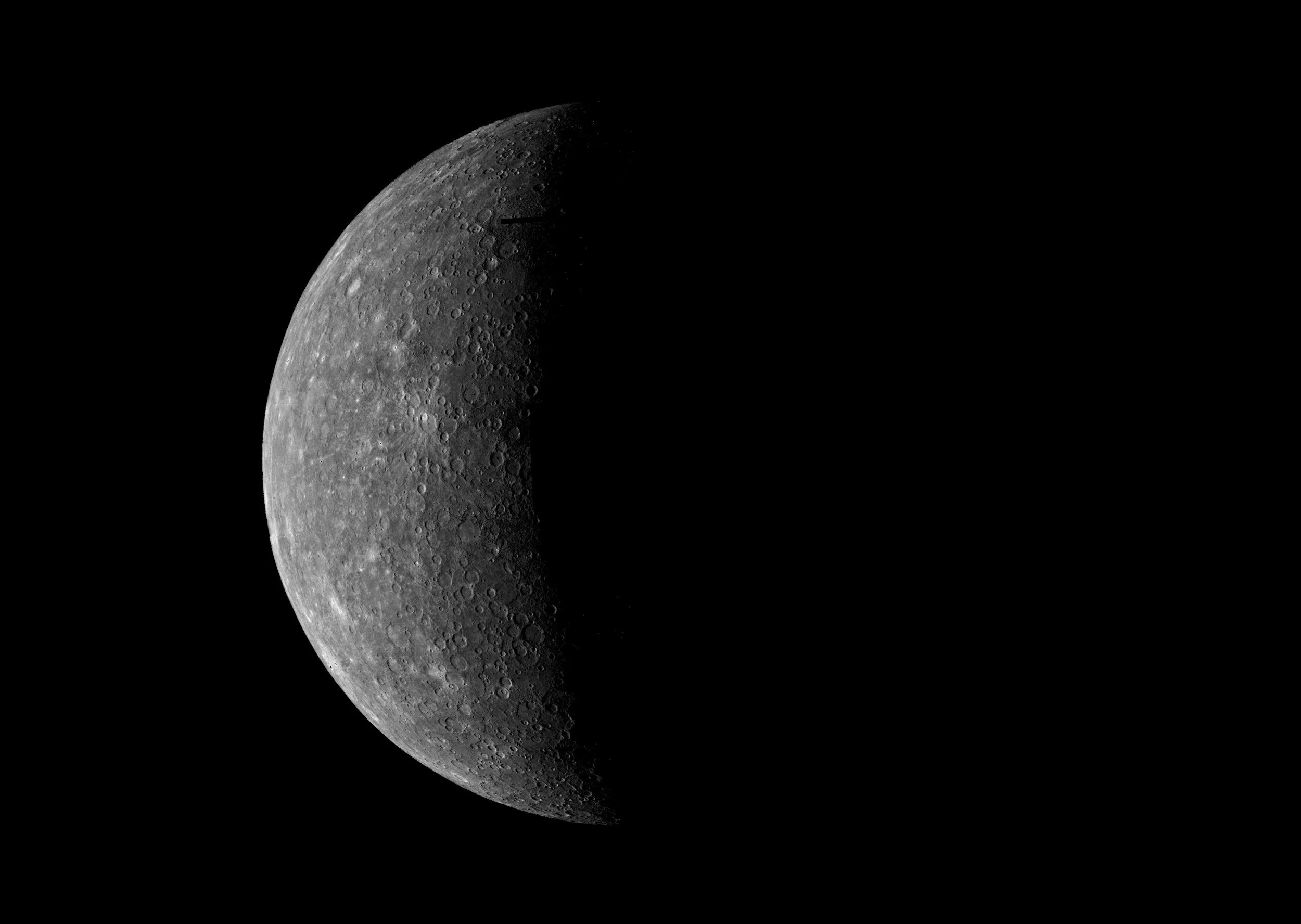
Mercury
Orbital characteristics:
Distance from star: 57.91 million kilometres (0.387 astronomical units)
Orbital period: 87.96 days
Natural satellites: 0
Space stations: 2 (Hermes Station, Vallis Station)
Physical characteristics:
Type: Hot terrestrial airless planet
Mass: 0.055 Earth masses
Radius: 2,439.7 kilometres (0.382 Earth radii)
Average temperature: 440 K (167 °C)
Habitability: Uninhabitable
Societal:
Colonised: 4 March 2100
Population: 12,370
Capital: Mendelssohn Science Centre
The Solar System’s innermost planet, Mercury is alternately baked and frozen as it revolves slowly around its axis. Its depth in the Sun’s gravity well and inhospitable surface conditions make colonisation and the exploitation of its mineral resources unviable even in the age of fusion torch engines. This has come as a boon to the World Union Department of Science: Mercury is a virtually pristine environment to study the formation of the Solar System, and its mineral resources allow for the construction of complex surface structures without the expense of importing raw materials from Earth. This and Mercury’s abundant solar power potential mean that several very large particle accelerators such as the Praxiteles Crater Supercollider have been built on the planet’s surface, where ultra-high energy collisions intended to simulate the conditions of the very early universe can be studied. The largest of these will be the Mercurian Equatorial Supercollider, currently under construction, which will ring the entire planet.
Mercury is jointly-governed by the Mercurian Administration of the Department of Colonial Affairs, and the Department of Science’s Advanced Research Agency. Over twelve thousand scientists and administrators work on or around the planet. Mercury is orbited by two space stations: Vallis Station is a fuel plant, operated by Eagle Fusion under World Union subsidies, that receives shipments of ice from craters of eternal darkness at Mercury’s poles to be cracked into fusion fuels for visiting ships. Hermes Station is operated by the World Union Department of Science and supports activities on the surface. Hermes Station is also the home port of the Space Patrol Service’s Mercury Flotilla, a standing patrol of Inner System Command that guards the Advanced Research Agency’s high-energy experiments and provides a forward-based search and rescue force for incidents that occur deep in the Sun’s gravity well.
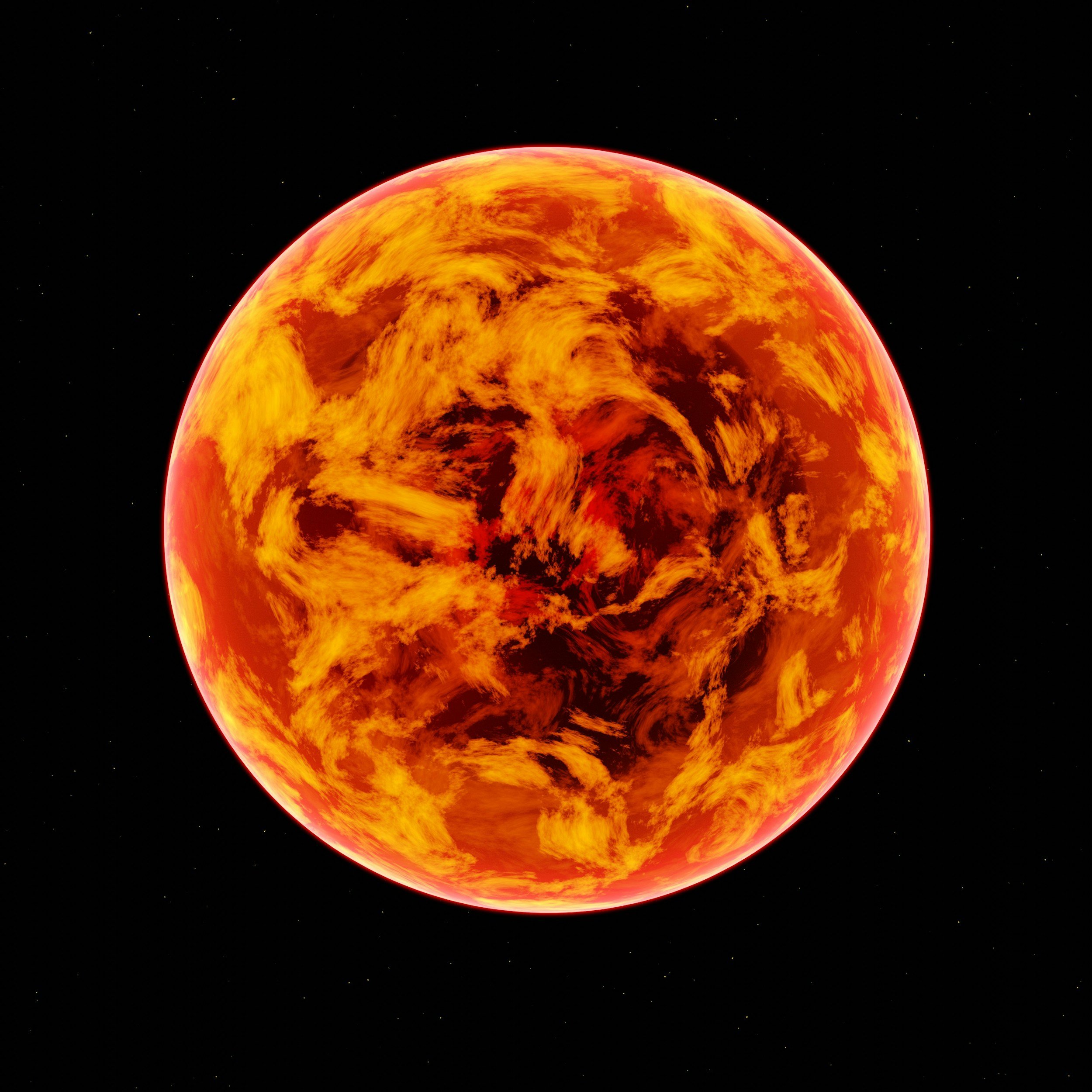
Venus
Orbital characteristics:
Distance from star: 108.21 million kilometres (0.723 astronomical units)
Orbital period: 224.7 days
Natural satellites: 0
Space stations: 5 (Aphrodite Station, Aeneas Station, Cupid Station, Priyah Station, SPSS Ishtar)
Physical characteristics:
Type: Hot terrestrial greenhouse planet
Mass: 0.815 Earth masses
Radius: 6,051.8 kilometres (0.95 Earth radii)
Average temperature: 737 K (464 °C)
Habitability: Uninhabitable
Societal:
Colonised: 17 April 2098
Population: >3,000
Capital: None (administered from Aphrodite Station)
The fog-shrouded hell of Venus is subject to two competing and often-incompatible forces: scientific inquiry and tourism. Scientists believe that billions of years ago Venus was a more Earthlike world, and expeditions are ongoing to determine whether it once supported life and if its fate provides any clues to the future of Earth. These endeavours are complicated by not just the baking temperatures and intolerable pressures of Venus’ surface, but also by throngs of tourists. The cloudtops of Venus have proved to be an unexpected tourist attraction, and crewed spaceplanes can make forays through the Venusian atmosphere at altitudes where the pressure is more tolerable before returning to space. The atmosphere is also plied by thirteen lighter-than-air craft. Most of these serve a scientific purpose, such as the UAS Caelus, an Astrographic Service airship that conducts detailed remote surveys of the Venusian surface, but one, Cloud Nine, serves as a luxury resort for up to 150 super-wealthy guests.
Venus is orbited by five space stations: Aphrodite Station, which receives scientific personnel and deploys probes to the surface; Aeneas and Cupid Stations, which support tourists; Priyah Station, which is in a higher orbit and acts as fusion fuel bunkerage for visiting ships; and SPSS Ishtar, the headquarters of the Space Patrol Service’s Inner System Command. Owing to its distance from the Asteroid Belt, piracy has never reached Venus and Mercury, though the Patrol is conscious of the attractions of super-rich tourists to criminal and terrorist groups. Inner System Command provides a moderate deterrence function, but is otherwise is the smallest of the Patrol’s standing commitments and its operations are largely focused on customs control, search and rescue, and emergency relief.