
The Space Patrol Service is the security, search and rescue, and law enforcement arm of the World Union for Space Policy. Formed in 2095 as a largely-unarmed policing and customs control service, the Space Patrol Service expanded significantly as commerce and colonisation extended to the Near-Earth Asteroids, Mars, and the Asteroid Belt. Following the explosion of violence in the Asteroid Belt in the Pirate Crisis of 2106, the Patrol became increasingly militarised and re-oriented its mission towards counter-piracy. Today, the Space Patrol Service operates a large, diverse, and technologically-advanced fleet of ships, performing piracy suppression in the Asteroid Belt, protecting spacegoing commerce, and providing emergency disaster relief. As of 2125, the Patrol numbers approximately 310,000 personnel and 220 spacecraft.
Organisation of the Space Patrol Service
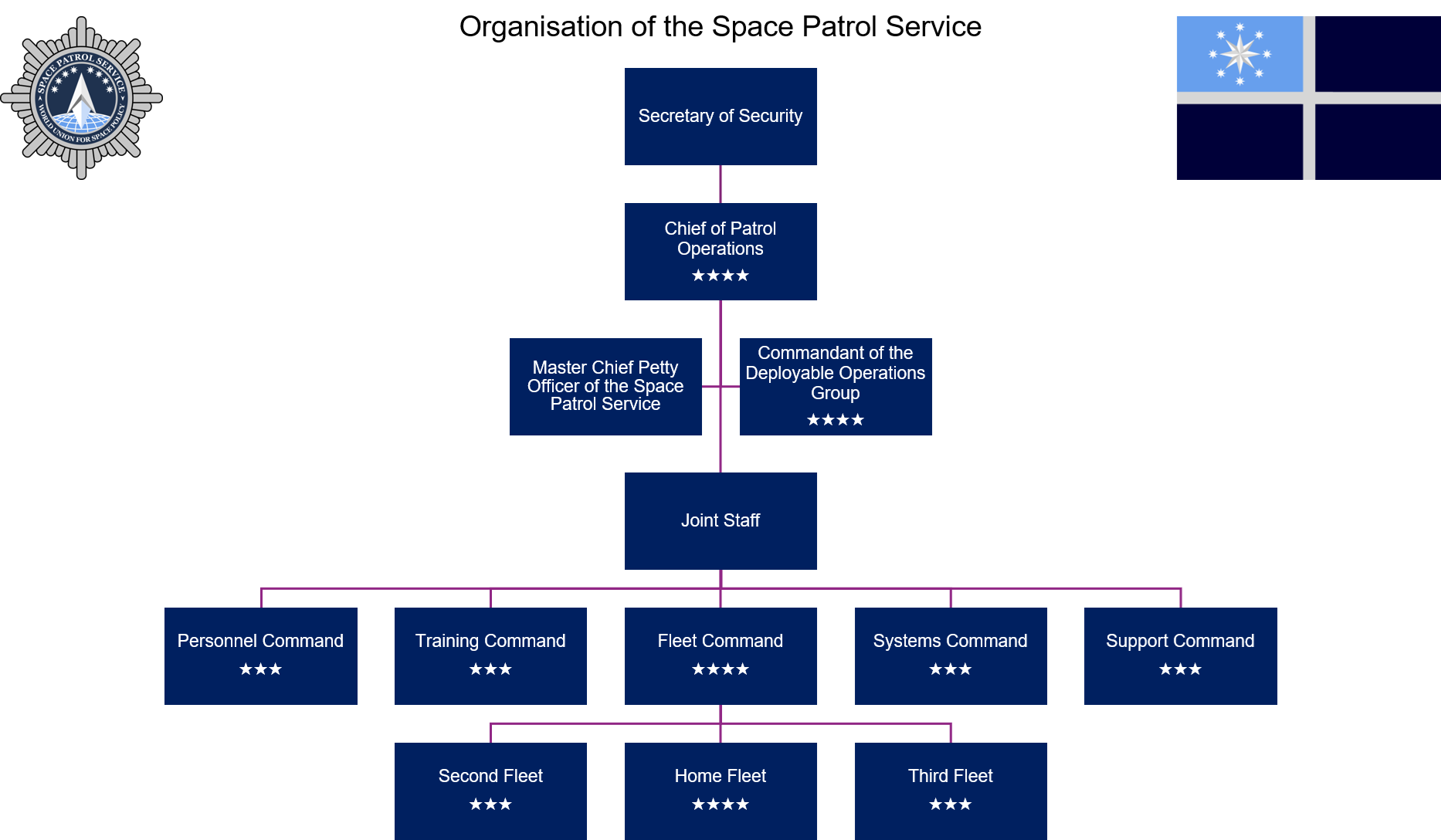
The Space Patrol Service is organised under the Department of Security, a cabinet-level department of the World Union Government, alongside its coequal the Deployable Operations Group, which provides ground forces in support of Patrol operations. The Space Patrol Service’s senior officer and professional head is the Chief of Patrol Operations, currently Admiral Roland Kaestner. The Chief of Patrol Operations is assisted by the Master Chief Petty Officer of the Space Patrol Service, the service’s most senior non-commissioned officer, and the Joint Staff. The Joint Staff is a body of specialist officers that includes develops the Patrol’s operational planning, long-term strategy, and contingency plans. Bodies that report directly to the Joint Staff include the Patrol Intelligence Department, the administrative commands, and the Patrol Medical Service.
Below the Joint Staff, the Space Patrol Service is split into administrative and operational commands. The administrative commands – Personnel Command, Systems Command, Support Command, and Training Command – are responsible for the recruitment, organisation, and equipping of the Patrol’s forces. Support Command includes the Patrol Medical Service, the Patrol Construction Force, and the Patrol Auxiliary Fleet, a civilian service that operates fifty-two supply ships to provide underway replenishment. The Patrol’s operating forces are controlled by Fleet Command, and organised into three fleets – the Home Fleet, the Second Fleet, and the Third Fleet, headquartered respectively at Earth, Venus, and Ceres – plus a number of smaller flotillas.
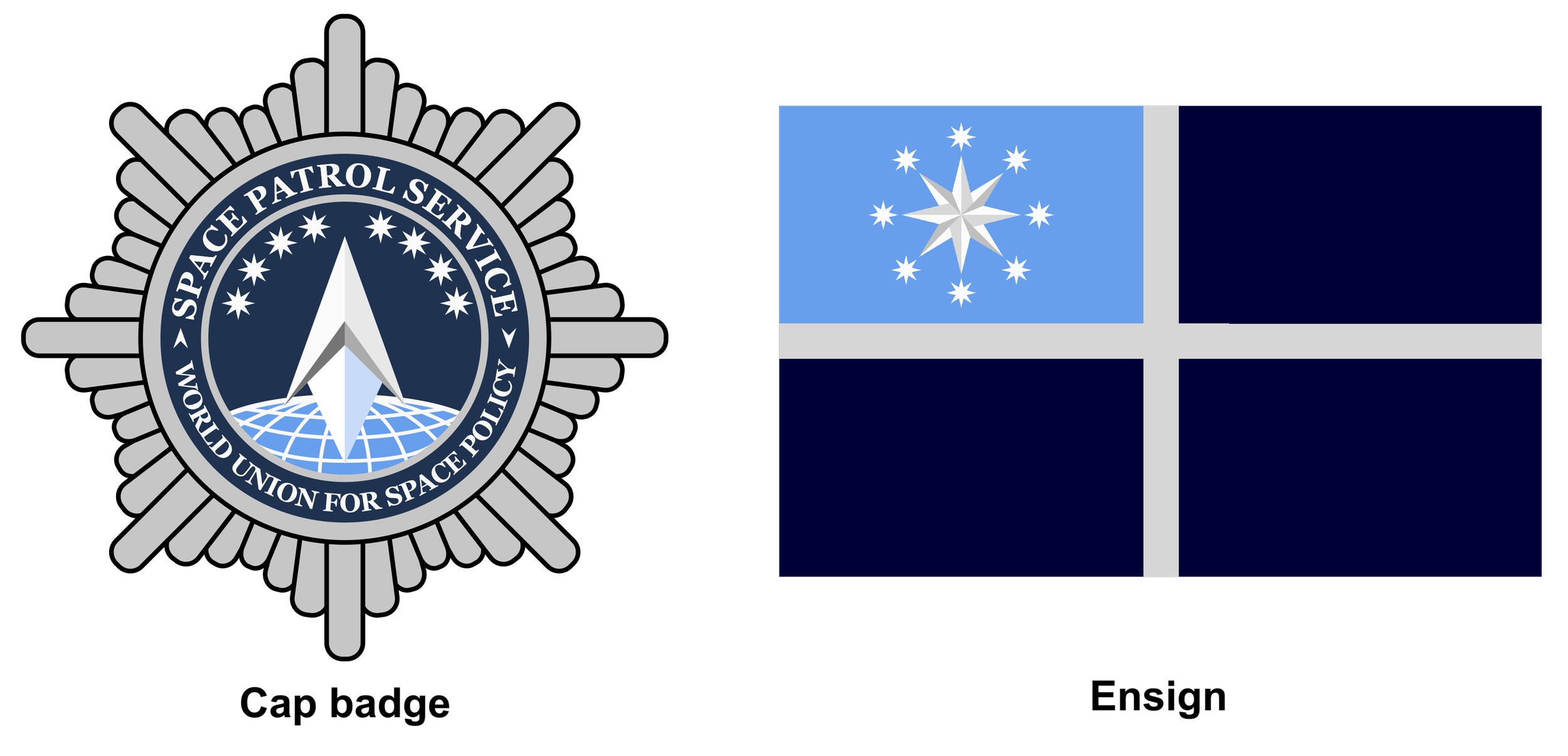
The Space Patrol Service’s cap badge is an eight-pointed Brunswick star, derived from the emblems of police services to reflect the Patrol’s original law enforcement function. The badge displays a delta, evocative of a spacecraft, rising above Earth towards the stars. The ensign of the Space Patrol Service consists of a silver cross on a dark blue field, with the flag of the World Union for Space Policy in the canton. In recognition of the historic placement of jacks and ensigns by seagoing navies, the flag of the World Union for Space Policy is painted on the fore hull of Patrol ships, while the ensign is painted on the aft hull. Like all ships the World Union Government service, Patrol ships are also marked with the Union Blue double “racing stripe”. Ships in Patrol service carry the prefix “SPS” – Space Patrol Ship.