
The Solar System: Jupiter and its moons
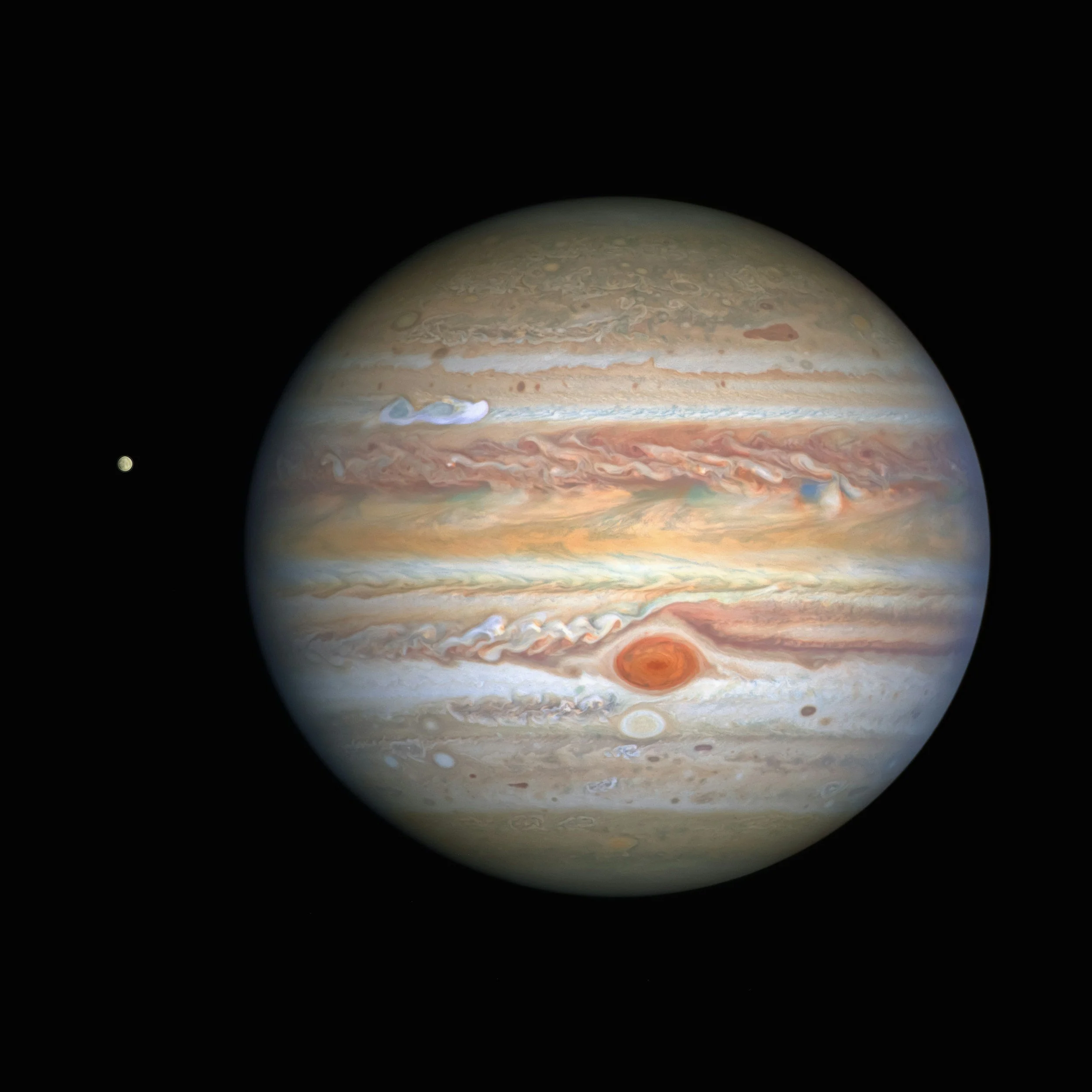
Jupiter
Orbital characteristics:
Distance from star: 778.5 million kilometres (5.2 astronomical units)
Orbital period: 11.6 years
Natural satellites: 4 major (Io, Europa, Ganymede, Callisto), >93 minor
Space stations: 2 (Marduk Station, Phaethon Station)
Physical characteristics:
Type: Cold Class I gas giant
Mass: 317.8 Earth masses (1 Jupiter mass)
Radius: 71,492 kilometres (11.2 Earth radii)
Average temperature: 165 K (-108.15 °C) at 1 bar atmospheric pressure
Habitability: Uninhabitable
Societal:
Colonised: 12 July 2112
Population: 700,000 (orbital and moon system)
The gas giant Jupiter is the largest planet in the Solar System. Composed of layers of liquid and metallic hydrogen and helium around a dense core, Jupiter’s intense radiation belt and extremely high escape velocity mean that there is very little permanent activity near the planet itself. Its moon system, however, forms the World Union’s most-recently-settled permanent colony: Jupiter is orbited by at least 97 natural satellites, of which the four largest – the Galilean moons – have been colonised. The Jovian moons are rapidly industrialising thanks to the ready availability of energy and mineral resources on Io, and cruise lines such as Martian & Beltward, Halifax, and Gillingham-Foyle are already considering the possibilities of tourism to Jupiter’s cloud bands and Great Red Spot.
Despite three survey expeditions between 2105 and 2110, the colonisation of Jupiter did not begin in earnest until 2112: following the Pirate Crisis of 2106, the Union Government was preoccupied with bringing piracy down to a manageable level, and feared a repeat of the near-disaster in the Asteroid Belt. The government of Secretary-General Gwyneth Aspell saw a new colonisation venture as a “return to normalcy” and confirmation of the World Union’s control of space. With budgets still tight following the Pirate Crisis, however, Aspell’s government chose to colonise the planet through the Jupiter Settlement Consortium, a public-private partnership of corporations. This proved deeply controversial, with opposition parties denouncing it as “the privatisation of colonisation”.
Jupiter is orbited by two space stations, the polar-orbiting Marduk Station, which studies Jupiter’s magnetosphere and atmosphere, and Phaethon Station, a passenger and cargo transfer station orbiting beyond Callisto.
Io
Orbital characteristics:
Distance from primary: 421,700 kilometres
Orbital period: 42.45 hours
Space stations: 1 (Styx Station)
Physical characteristics:
Type: Cold rocky volcanic moon
Mass: 0.015 Earth masses
Radius: 1,821.6 kilometres (0.285 Earth radii)
Average temperature: 110 K (-163.15 °C)
Habitability: Uninhabitable
Societal:
Discovered: 1610
Colonised: 29 November 2112
Population: <150
Capital: None (administered from Styx Station)
The tortured volcanic moon of Io is not an obvious target for colonisation: wracked by tidal forces from Jupiter, the moon has over 400 active volcanoes and orbits deep in the planet’s radiation belt. Fuel costs to both reach and land on the moon are prohibitive. Nevertheless, Io has been central to the settlement and development of Jupiter’s moon system: unlike the rest of the Galilean moons, which are composed of ices, Io is composed of silicate rock, meaning it has a wealth of mineral resources relatively close to its surface that are essential for making Jupiter a self-sufficient colony.
Io has two large surface mines on the Bosphorus Regio. These are overwhelmingly automated and manned by only fifty personnel each in buried habitats. These also support the Astrographic Service’s geological survey teams studying Io’s volcanoes. Jupiter’s intense radiation belt also means that Io is now the Solar System’s centre for the spallation of elements into industrial and medical radioisotopes. Ore and refined metals are transferred to Styx Station in orbit of the moon for onward transport.
Europa
Orbital characteristics:
Distance from primary: 760,900 kilometres
Orbital period: 3.55 days
Space stations: 1 (Minos Station)
Physical characteristics:
Type: Cold icy airless moon
Mass: 0.008 Earth masses
Radius: 1,560.8 kilometres (0.245 Earth radii)
Average temperature: 102 K (-171 °C)
Habitability: Simple life-sustaining, non-human-habitable
Societal:
Discovered: 1610
Colonised: 25 October 2112
Population: <5,000
Capital: Pwyll Base
Seen from space, Europa appears barren and uninhabitable, but beneath its thick icy crust is an immense ocean over one hundred kilometres deep. The Europan Ocean is home to the only known extraterrestrial biosphere: kept liquid by tidal heating from Jupiter, the ocean supports a population of extremophile organisms on the tops of underwater guyots and around hydrothermal vents on the ocean floor. The most common animal analogues include species resembling gastropods, shrimps, and tube worms, though scientists are quick to point out that these species evolved totally independently to Earth animals and any comparison is likely to be misleading. Bacterial and algal analogues also drift freely in the oceans or form colonies on the underside of the icy crust.
Tidal heating from Jupiter means that Europa’s crust is extremely thin, no more than thirty kilometres thick and narrowing to only two hundred metres in places. Recognising that any attempt at colonisation is likely to irreparably damage a unique, pristine biosphere, the World Union has declared Europa a nature reserve under planetary protection guidelines. The World Union Astrographic Service explores the moon from Pwyll Base in the southern hemisphere, which includes a fleet of seven submarines. The alien life of the Europan Ocean, including the Valley of the Annelids, which hosts immense tube worms around enormous black smokers, and the Kurtz Seamounts, vast underwater peaks coated with brilliant red clams and molluscs, has captured the public imagination: several cruise companies have sought to open negotiations with the Union Government to allow tourism. However, the Department of Science is steadfast that there can be no change to Europa’s protected status.
Ganymede
Orbital characteristics:
Distance from primary: 1.07 million kilometres
Orbital period: 7.15 days
Space stations: 1 (Ilus Station)
Physical characteristics:
Type: Cold icy airless moon
Mass: 0.025 Earth masses
Radius: 2,634 kilometres (0.413 Earth radii)
Average temperature: 110 K (-163 °C)
Habitability: Uninhabitable
Societal:
Discovered: 1610
Colonised: 7 August 2112
Population: <10,000
Capital: Ninki Habitat
The largest moon in the Solar System, Ganymede is larger than the planet Mercury. Like Europa, Ganymede has an ocean of liquid water below its surface, but its distance from Jupiter means it is less subject to tidal heating and so has a much thicker crust. The World Union allowed the colonisation of Ganymede to proceed on the grounds that it was far less likely to affect indigenous life than on Europa.
Ganymede would be ideal for mass settlement but for Jupiter’s radiation, which is still dangerously high even one million kilometres from the planet. All habitats on Ganymede must be tunnelled into the moon’s icy crust, which has discouraged large-scale settlement. Instead, Ganymede is Jupiter’s fuel depot: ice mined on the surface is transferred to Ilus Station in orbit to be processed into fusion fuels.
Callisto
Orbital characteristics:
Distance from primary: 1.88 million kilometres
Orbital period: 16.68 days
Space stations: 4 (Callisto Passenger Transfer Station, Callisto Cargo Complex, Sarakka Shipyards, SPSS Deipaturos)
Physical characteristics:
Type: Cold icy airless moon
Mass: 0.018 Earth masses
Radius: 2,410 kilometres (0.378 Earth radii)
Average temperature: 134 K (-139.15 °C)
Habitability: Uninhabitable
Societal:
Discovered: 1610
Colonised: 12 July 2112
Population: 650,000
Capital: Valhalla
Jupiter’s second-largest moon, Callisto is the only Galilean moon to orbit outside the radiation belt. Callisto has become Jupiter’s largest population centre and the site of the vast majority of economic, scientific, and industrial activity around the gas giant. The Callistoan capital of Valhalla is the moon’s largest habitat and Jupiter’s administrative centre. With a population of 650,000, Callisto is the largest colony outside the Inner Solar System.
The development of mining on Callisto has been slow compared to Ganymede owing to Callisto’s scientific significance: at 4.5 billion years old, the moon’s heavily-cratered surface is the oldest in the Solar System. This is of profound interest to astrogeologists, and it offers clues to the Solar System’s formation. Like Ganymede and Europa, Callisto has a subsurface ocean that may support life, though this has yet to be explored owing to its depth below Callisto’s icy crust, which is between 80 and 150 kilometres thick.
Callisto is orbited by the Sarakka Shipyards, which are the main builder of ships travelling between Jupiter’s moons, and are slowly expanding to build interplanetary vessels for convoys to the Inner Solar System. Callisto is also orbited by SPSS Deipaturos, the home port of the Jupiter Flotilla, part of the Space Patrol Service’s Outer System Command, which provides search and rescue duties around Jupiter and security to convoys of radioactive materials returning from Jupiter to the Inner Solar System.