
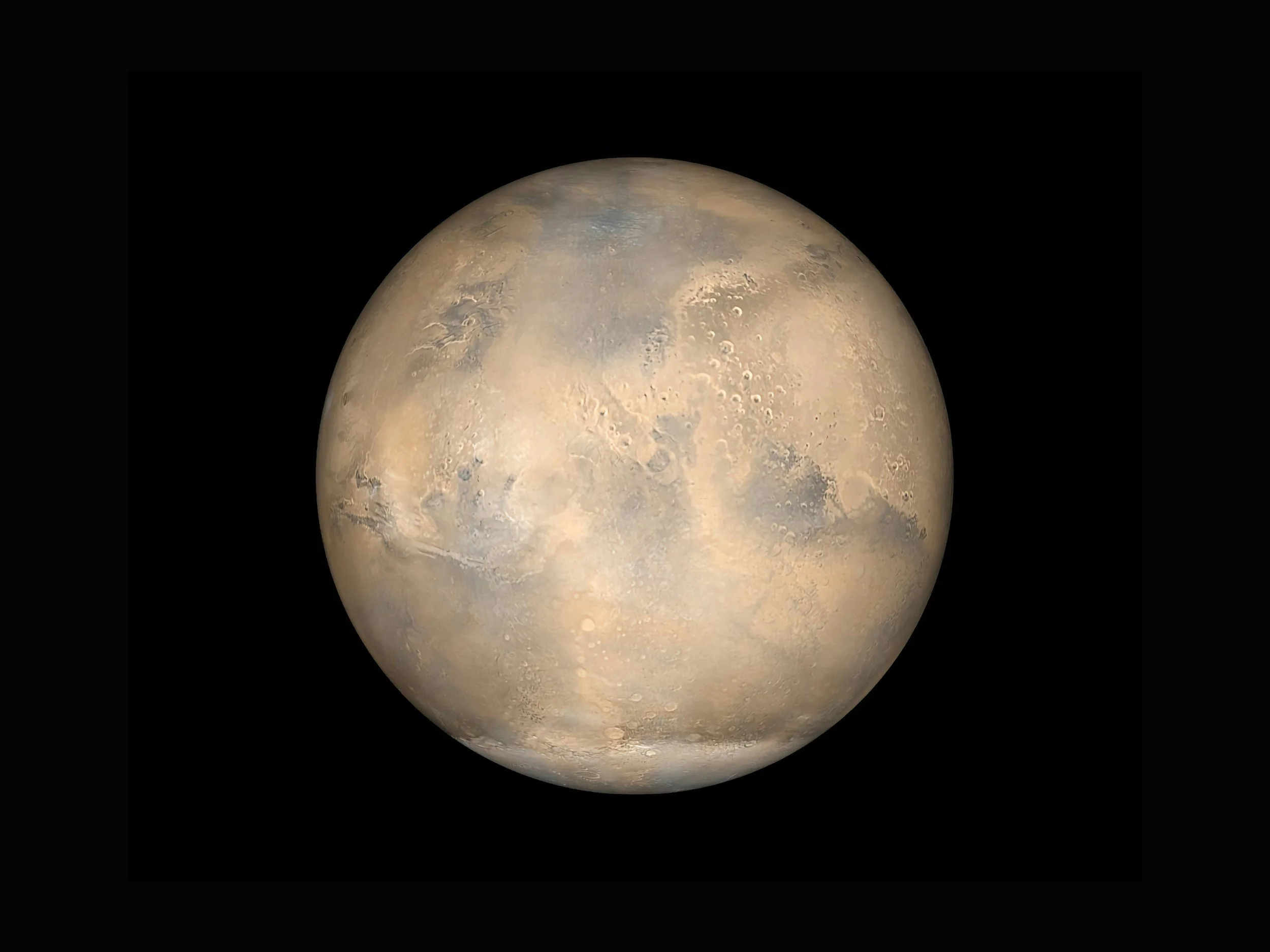
Mars
Orbital characteristics:
Distance from star: 227.9 million kilometres (1.523 astronomical units)
Orbital period: 687 days
Natural satellites: 2 (Phobos, Deimos)
Space stations: 6 (Mangala Station, Boreum Transfer Station, Australe Transfer Station, Nergal Cargo Handling Station, Horus Bunkering Station, SPSS Ares)
Physical characteristics:
Type: Cool terrestrial desert planet
Mass: 0.107 Earth masses
Radius: 3,389.5 kilometres (0.533 Earth radii)
Average temperature: 213 K (-60 °C)
Habitability: Uninhabitable
Societal:
Colonised: 13 March 2097 (mass colonisation, semi-permanent human presence since 2040s)
Population: 2 million
Capital: Tyndall Habitat
The Red Planet has not lived up to the aspirations of ages past: radiation and the toxic, perchlorate-rich soil make it unattractive for industrial development, while its relatively high gravity and thin atmosphere complicate both take off and landing. Big business has largely avoided Mars in favour of further developing Luna or staking claims in the Asteroid Belt.
All of this suits the Martian Administration very well, however, which sees its role as facilitating scientific endeavour on Mars. Fully two-thirds of Mars’ population of two million are scientists, who since arriving in 2097 have been responsible for many Nobel Prize-winning discoveries, including conclusively proving that Mars was once a warm, wet planet that supported microbial life. Most scientific research on Mars is conducted out of Melas Chasma Base, a sprawling collection of habitats around the site of the first manned landing on Mars in the last century. This ad hoc, unguided expanse of settlements proved unsuitable for longer-term habitation, especially once scientists began to bring their families to Mars, and purpose-built habitats have been established at Tyndall Crater, Coronae Scopulus, and Olympus Mons. Coronae Scopulus Habitat, in the Hellas Planitia, is also the site of Mars’ limited industry, producing the vast majority of mineral resources and spare parts the planet needs to maintain self-sufficiency.
The remainder of Mars’ population is made up by a never-ending stream of tourists and their support staff, largely based out of Olympus Mons Habitat. Sites such as the Valles Marineris, the Noctis Labyrinthus, or the Jorgensen Expedition Memorial draw hundreds of thousands of tourists ever year, though their numbers are more limited than those of Luna because of the greater time and expense in reaching Mars. This relatively lower rate of tourism has allowed the Martian Administration to balance the expansion of resorts against scientific interests.
Phobos
Orbital characteristics:
Distance from primary: 9,376 kilometres
Orbital period: 0.318 days (7 hours, 39 minutes, 12 seconds)
Space stations: 1 (Pavor Station)
Physical characteristics:
Type: Cool rocky irregular moon
Mass: 1.060×10¹⁶ kg
Radius: 11 kilometres (average)
Average temperature: 233 K (-40.15 °C)
Habitability: Uninhabitable
Societal:
Discovered: 1877
Colonised: 20 January 2098
Population: 1,000 (750 orbit, 250 surface)
Capital: None (administered from Pavor Station)
Mars’ inner moon has a minimal human presence: Phobos is a “rubble pile” subject to dangerous tidal interactions by Mars, and so mining operations to harvest its water and volatiles are entirely robotic, directed from only one ground station and a supporting orbital base, Pavor Station. Mining rights to the moon are owned entirely by PhobosPhuel Ltd, a small fusion and rocket fuel production concern that handles most bunkering for travel between Mars and its moons. Phobos is occasionally subject to illegal mining by Belt pirates, though its distance from the Asteroid Belt and high surveillance around Mars means that this is only an option taken by the most desperate.
Deimos
Orbital characteristics:
Distance from primary: 23,463 kilometres
Orbital period: 1.263 days
Space stations: 0
Physical characteristics:
Type: Cool rocky irregular moon
Mass: 1.51×10¹⁵ kg
Radius: 6.27 kilometres (average)
Average temperature: 233 K (-40.15 °C)
Habitability: Uninhabitable
Societal:
Discovered: 1877
Colonised: 18 January 2098
Population: 40,000
Capital: Voltaire Habitat
Mars’ outer moon has become an unlikely player in the Solar System’s economy: beginning life as a waystation in support of the exploration of Mars, fusion fuels and complex organics extracted from Deimos’ ice and carbonaceous regolith not only made Mars self-sufficient, they also made the moon ideally-placed to support the colonisation of the Asteroid Belt. Deimos’ Voltaire Habitat, the only settlement on the moon, today supports a brisk trade of fuelling and servicing cruise liners. It also captures some of the tourists heading to Mars with such amenities as the luxurious Hotel Arean, whose observation dome offers spectacular views of the Red Planet dominating the sky. While most taxes are reserved to Martian Authority or the World Union, the Deimosian Council follows a policy of offering low rates and offsets to businesses and entrepreneurs in an effort to diversify the moon’s economy away from resource extraction.
Deimos is formally under the control of the Martian Administration, but “Deimosian not Martian” is a frequent refrain among its permanent residents, whose commercial outlook is very different to the scientifically-minded worldview of Mars. Devolutionist political groups demanding greater tax-setting powers for Deimos have achieved some success in Martian elections, though to a far lesser degree to those on Ceres.