
The Solar System: Saturn and its moons
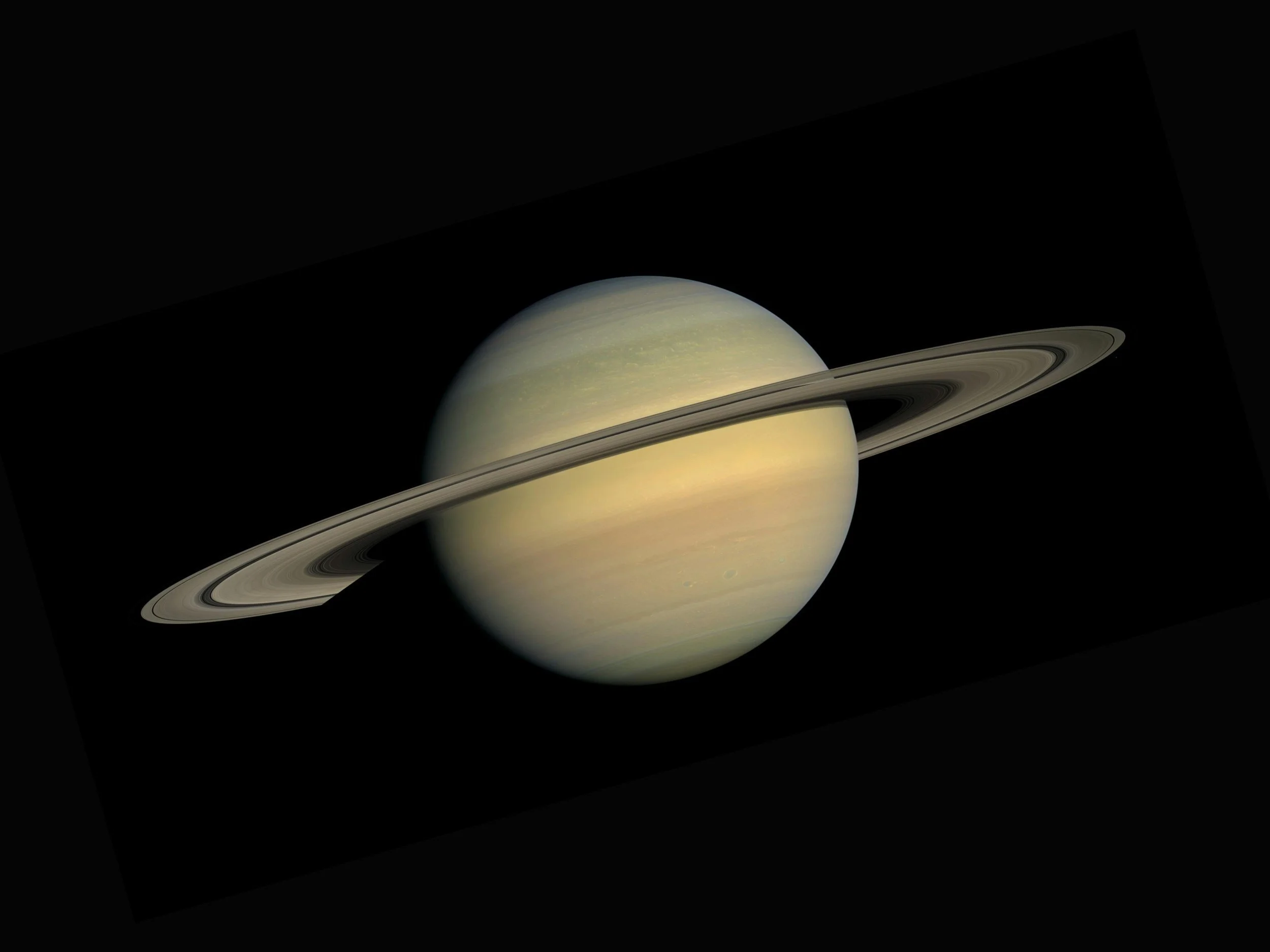
Saturn
Orbital characteristics:
Distance from star: 1.43 billion kilometres (9.58 astronomical units)
Orbital period: 29.44 years
Natural satellites: 7 major (Mimas, Enceladus, Tethys, Dione, Rhea, Titan, Iapetus), >267 minor
Space stations: 0
Physical characteristics:
Type: Cold Class I ringed gas giant
Mass: 95.159 Earth masses (0.299 Jupiter masses)
Radius: 58,232 kilometres (9.14 Earth radii)
Average temperature: 134 K (-139.15 °C) at 1 bar atmospheric pressure
Habitability: Uninhabitable
Societal:
Colonised: 2125 (planned)
Population: None permanent at time of writing
The ringed gas giant Saturn is the most promising colony site in the Outer Solar System. Both distance and budgetary concerns mean that Saturn has been visited only twice by manned expeditions, one of which is ongoing at time of writing. Nevertheless, their discoveries have encouraged the Union Government to approve the colonisation of the Solar System’s second-largest planet: Saturn’s rings and moon system are rich in ices and complex organics, with remarkably low delta-V requirements for travel between the moons, while Saturn’s radiation belt and gravity well are far more clement than Jupiter’s. At three months’ travel from Earth with standard fusion torch engines, Saturn is at the limit of colonisation, though improvements in technology are expected to significantly reduce this in coming years. Saturn is expected to serve as a hub for further exploration and colonisation of the Outer Solar System, reducing the need to ship supplies from Earth.
After the success of the First Saturnian Expedition in 2115, the World Union tendered a contract for a public-private partnership for the colonisation of Saturn. After prolonged negotiations, the contract was given to the Swallow Corporation in 2123. The involvement of the Swallow Corporation was controversial: Saturn is the company’s first venture into colonisation, while the political and social views of its CEO, Emiel Bekker, have made him a polarising figure. The great distance of Saturn from Earth also saw accusations that the Union Government was pursuing a dubious colonisation scheme for the sake of headlines and private profits. Nevertheless, the Swallow Corporation and its subsidiaries successfully assembled and launched a colonisation fleet on 22 April 2125, which is expected to arrive at Saturn in July 2125. The World Union Astrographic Service’s Second Saturnian Expedition is currently scouting the planet to confirm colonisation sites prior to the fleet’s arrival.
With seven large moons and over 260 smaller natural satellites, Saturn has the largest moon system in the Solar System. Only those significant to colonisation are listed here.
Mimas
Orbital characteristics:
Distance from primary: 185,539 kilometres
Orbital period: 22.6 hours
Physical characteristics:
Type: Cold icy airless moon
Mass: 3.7509×10¹⁹ kg
Radius: 198.2 kilometres (0.031 Earth radii)
Average temperature: 64 K (-209.15 °C)
Habitability: Uninhabitable
Societal:
Discovered: 1789
Mimas is the innermost and smallest of Saturn’s large moons. It is the smallest known Solar System body to remain rounded under its own gravity. Composed largely of water ice, Mimas’ depth in Saturn’s gravity well makes it unprofitable for mining. However, its enormous, hemisphere-spanning Herschel crater is of great interest to astronomers: formed by an ancient impact that almost shattered the moon, Herschel is planned to host an immense radio telescope, larger than even the Daedalus Crater Radio Telescope on the far side of Luna. Mimas’ low gravity will allow for an enormous but extremely lightweight wire-mesh structure almost 140 kilometres across.
Enceladus
Orbital characteristics:
Distance from primary: 238,037 kilometres
Orbital period: 1.37 days
Physical characteristics:
Type: Cold icy airless moon
Mass: 1.0803×10²⁰ kilograms
Radius: 252.1 kilometres (0.040 Earth radii)
Average temperature: 75 K (-198.15 °C)
Habitability: Uninhabitable
Societal:
Discovered: 1789
The shining white moon of Enceladus has been intensively studied by the two Astrographic Service expeditions to Saturn: orbital resonance with Dione provokes tidal heating in Enceladus’ subsurface ocean, which bursts to the surface through more than one hundred cryovolcanic geysers at the south pole. Water vapour falling back to the surface blankets Enceladus in a layer of snow hundreds of metres thick.
From analysis of jets from Enceladus’ geysers, the subsurface ocean almost certainly supports life. Tidal heating means that, unlike Saturn’s other moons, Enceladus’ icy shell is only about five kilometres thick. While Emiel Bekker has publicly speculated about the possibilities of tourism to Enceladus’ geysers, or of using the subsurface ocean to access minerals deep inside the moon, the Department of Science and the Swallow Corporation have agreed to a ten-year planetary protection agreement to preserve Enceladus’ likely life and allow further study of the moon.
Titan
Orbital characteristics:
Distance from primary: 1.221 million kilometres
Orbital period: 15.945 days
Physical characteristics:
Type: Cold icy hydrocarbon moon
Mass: 0.0225 Earth masses
Radius: 2,574.7 kilometres (0.404 Earth radii)
Average temperature: 94 K (-179.45 °C)
Habitability: Uninhabitable
Societal:
Discovered: 1655
The second-largest moon in the Solar System, Titan is the only natural satellite known to have a thick atmosphere, and the only body other than Earth know to support permanent surface liquid. Beneath the hazy, nitrogen-methane atmosphere, Titan’s icy crust is covered with black rivers and lakes of liquid hydrocarbons. Titan is ideal for colonisation: the atmosphere provides a radiation shield, and its natural weather systems will provide wind power to future colonies. The hydrocarbon lakes and rivers are well-placed both to provide hydroelectricity to colonies, and for mineral exploitation. Titan’s hydrocarbons have the potential to substantially replace complex organic products such as plastics and fertilisers that presently can only be sourced from Earth. This will drastically reduce shipping costs and remove a key obstacle to expanding humanity’s presence in space. In addition to its economic potential, Titan’s striking orange skies, canyons and valleys, and rivers and waterfalls of methane are expected to become tourist attractions in future.
Scientists continue to debate whether primitive life is possible on Titan: lipid-based life consuming carbon dioxide and using liquid methane as a solvent is theoretically possible in Titan’s temperatures. However, unlike Enceladus, the World Union Department of Science has not approved a planetary protection agreement for Titan, as the indicators for life were considered too sparse and Titan too important a colonisation site. This has provoked intense disquiet within the scientific community, which believes that a potential biosphere is being sacrificed to the demands of politics and business profits. The Swallow Colonisation Fleet plans to establish a settlement in Titan’s northern polar region, where the Vid Flumina flows into the Ligeia Mare, Titan’s second-largest lake. Ligeia Base will be supported by the first laser launch facility in the Solar System: this will significantly reduce launch costs from Titan and will be a proof of concept for similar facilities to be established at spaceports across the Solar System.
Iapetus
Orbital characteristics:
Distance from primary: 3.56 million kilometres
Orbital period: 79.321 days
Physical characteristics:
Type: Cold icy airless moon
Mass: 1.8056×10²¹
Radius: 734.4 kilometres (0.115 Earth radii)
Average temperature: 110 K (-163.15 °C)
Habitability: Uninhabitable
Societal:
Discovered: 1671
The outermost of Saturn’s large moons, Iapetus is the first target of the Swallow Colonisation Fleet. Its low gravity and ease of access make it ideally placed for a fuel facility, which the Swallow Corporation plans to establish at Corsablis Crater to mine the moon’s ice and rock. Corsablis Crater is a gap in the Toledo Montes, a mountain range that forms part of an immense equatorial ridge that runs three-quarters of the way around Iapetus. Twenty kilometres tall at its highest point, Iapetus’ equatorial ridge is the third-highest mountain range in the Solar System. Iapetus is also distinguished by the striking contrast between its dark and light hemispheres.
Owing to Iapetus’ low gravity, Corsablis Base is not expected to be a permanent settlement, but will be a stepping-stone for the colonisation of Titan. Once this is complete, it is expected that Corsablis Base will become largely automated. Emiel Bekker has promoted the idea of the moon becoming a holiday resort: Iapetus’ highly inclined orbit means that it is the only Saturnian moon from which the ring system is clearly visible.