
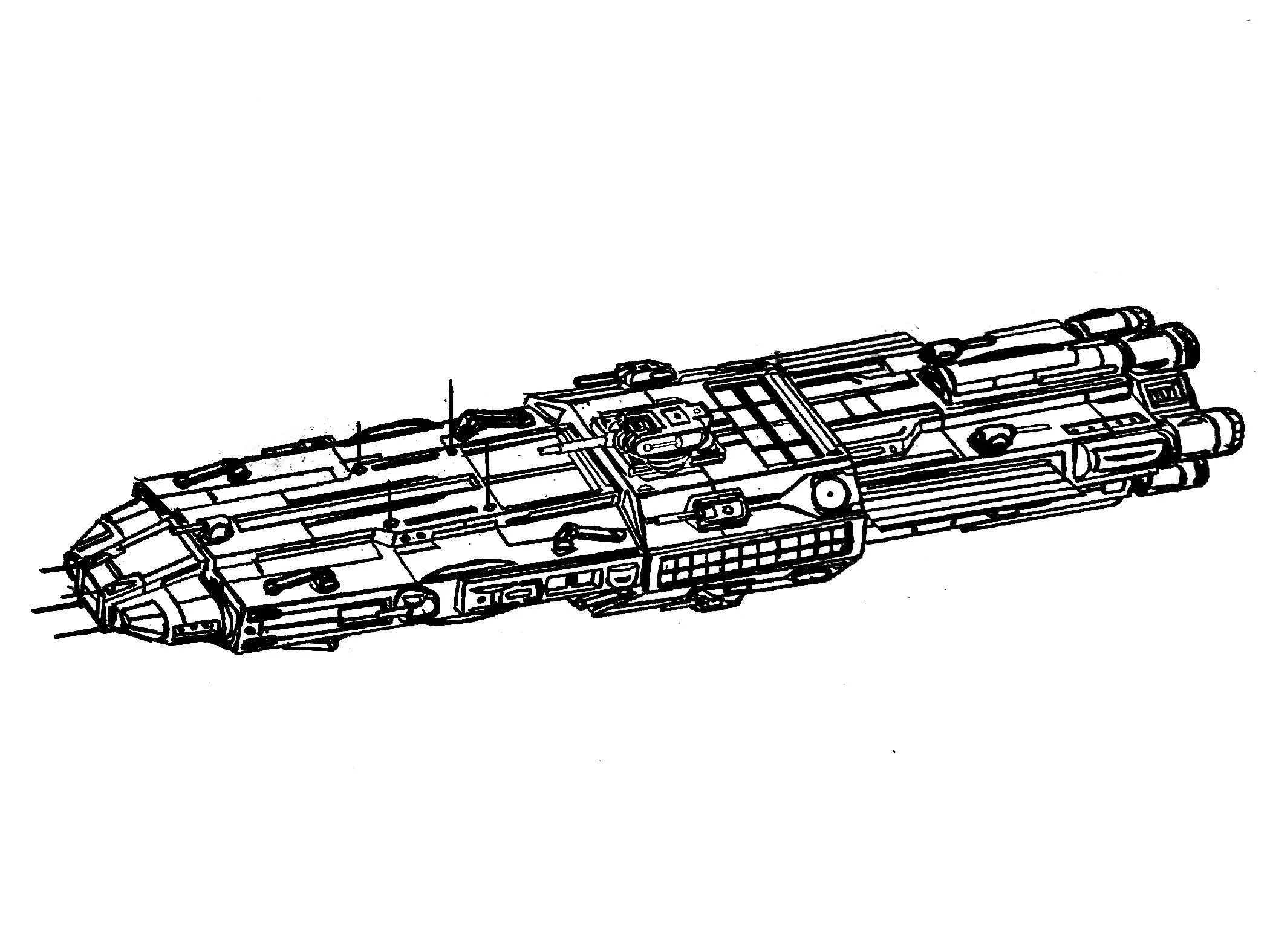
One of the Space Patrol Service’s most modern combatants, the Blackwood-class was the first cutter to be designed after the Patrol had been able to gather significant data from combat with the pirates. Designed under the “Space Security Cutter, Large” (SSL) programme, the Blackwood-class is uncompromisingly optimised for missile combat, carrying 50 per cent more missiles than its predecessor, the Constellation-class. Unlike the Constellation-class, which was designed and launched in a hurry following the Pirate Crisis, the Blackwood-class is designed with future upgrades and modernisation in mind. Today the Patrol’s most numerous large combatant, the Blackwood-class is expected to be in service for at least forty years.
At a length of 138 metres and a maximum hull diameter of 54.8 metres, the Blackwood-class is the largest design of cutter yet built for the Space Patrol Service. The cutter has the chisel-like appearance and the hexagonal cross-section characteristic of modern Patrol craft, and consists of three sections: the fore hull contains the docking ports, small craft bay, and majority of sensor emitters and crew accommodation. The central hull or “citadel” is the shortest, but the widest and most-heavily-armoured, and contains command facilities, the fusion reactor, and the majority of weapon systems. The aft hull is the narrowest but longest element of the ship, and contains the fusion engines, propellant tanks, and radiators for the fusion reactor. The Blackwood-class’ hull surfaces are angled to reduce the ship’s radar cross-section, though it lacks the more elaborate low observable technologies of the later Paris-class cruiser.
The cutter is propelled by four Solar Dynamics D/3HE-2118 fusion torch engines, burning pellets of deuterium and helium-3 fuel in a magnetically-insulated inertial confinement fusion (MICF) reaction. Fully fuelled, the Blackwood-class can sustain an acceleration of 0.03 g. This is sufficient for a 100-day round trip from Earth to Ceres, or a 63-day one-way trip to Jupiter, before refuelling. In extremis, the Blackwood-class can produce a “sprint” acceleration of up to 0.07 g, but this cannot be sustained for more than a few hours before the engines suffer irreparable heat damage.
The cutter is built around the missile as its primary offensive weapon. Missiles are fired from two models of vertical launch system (VLS). The Blackwood-class carries dorsal and ventral batteries of eight Mark 56 “strike length” VLSs, typically loaded with the Patrol’s standard anti-ship missile, the SSM-7 Leister. Cutters assigned to escort the Orbital Landing Group replace up to eight Leister missiles with SGM-11 Retiarius surface-attack missiles. The Blackwood-class also mounts port and ventral starboard of twenty-four Mark 37 “tactical length” vertical launch cells, firing the SMM-8 Kakivak, designed to both attack light shipping and serve as a countermissile.
The Blackwood-class carries two 4.5 in Mark 7 100 MJ heavy coilgun turrets as its secondary offensive armament, designed for engaging targets too small for missiles, orbit-to-surface attacks, and complementing the ship’s missile defence. Coilguns accelerate a ferromagnetic projectile through a series of staged coils, and offer much higher muzzle velocities than conventional guns. The Mark 7 fires both armour-piercing molybdenum permalloy shells, and hull-shredding tungsten canister shot. The Blackwood-class’ point-defence consists of four Mark 2 30mm autocannons and eight Mark 4 Block 2B 20mm rotary guns. The Mark 2 autocannon can support an offensive plan by firing clouds of projectiles to deny trajectories to an enemy and force it on to disadvantageous vectors, while the Mark 4 is a dedicated close-in weapon system (CIWS) designed to destroy missiles that have penetrated the ship’s outer defences at short range.
The experience of combat with the pirates led to the class receiving significantly heavier armour than any ship previously in service. The Space Patrol Service is naturally reticent to publicly discuss its armour schemes, however official press releases indicate that the Patrol considers high-velocity, low-mass kinetic projectiles, such as those released by a missile’s fragmentation warhead, to be the primary threat. The Blackwood-class’ armour is based on the Whipple shield principle, incorporating a thin but tough “bumper” layer to disrupt and break up a penetrator, a spacer to disperse the projectile’s fragments, and a thick “splash” layer to absorb their kinetic energy. Long-range telescopy of ships damaged in action indicates that the Blackwood-class makes use of a three-layer Whipple shield composed of vanadium-chromium steel bumper layers and amorphous carbon and ultra-high molecular weight polyethylene (UHMWPE) splash layers to protect the ship’s hull, backed by a thick vanadium-chromium steel structural layer. Crew spaces and vital machinery are protected by additional UHMWPE spall liners.
The Blackwood-class’ sensor array was the most advanced ever deployed in space until the launch of the Paris-class cruiser in 2122. It includes passive electromagnetic and active lidar and radar sensors. The Blackwood-class’ primary passive sensor is the SSR-95 All-Aspect Navigation System, which consists of multiple thermal detector arrays built into the outer hull that continually collect data on infrared signatures. The SPY-54 Fire Control Radar is the primary active sensor, combining quantum radar technology with an active electronically scanned array that spreads signal emissions across a wide range of frequencies, making it difficult to detect over background noise and reducing its probability of interception. Quantum radars have significantly improved range, jam-resistance, and signal quality compared to classical systems, as well as lower power requirements. The SPY-54’s thousands of transmitting and receiving modules are grouped into four antenna arrays on the Blackwood-class’ fore hull. These can track up to 5,000 targets simultaneously. Variants of the SPY-24 radar equip the Paris-class cruiser and the Patrol’s orbital landing ships, with only minor adjustments and improvements.
The Blackwood-class’ sensors support an extensive electronic countermeasures (ECM) system. The Space Patrol Service has invested heavily in ECM since the terrible casualties of the Pirate Crisis of 2106-07 to improve survivability. The Blackwood-class’ SLQ-24 Electronic Countermeasures System, SEQ-17 Laser Countermeasures System, and SYQ-58 Cyber Attack System provide electronic, directed-energy, and cyber attack capability against attacking missiles. The SLQ-24 is capable of directing the entire power of the Blackwood-class’ radars into jamming, including responsive AI-directed spot, barrage, sweep, and repeater jamming to defeat missile locks and block data links. The countermeasures system is linked to the ship’s decoy launchers, which can deploy chaff to disrupt radars, or fusion decoys: the SDD-17 Ancilla fusion decoy is designed to mimic the thermal and engine signature of the Blackwood-class to confuse infrared seekers and draw missiles away from the ship. Each Ancilla decoy burns for fifteen seconds before losing power and being destroyed by the intensity of its emissions.
The Blackwood-class cutter is a multi-mission ship, designed for convoy defence, fleet actions, and surface attack. Since the launch of the SPS Blackwood in 2119, it has proved to be one of the Patrol’s most successful designs. The Patrol originally planned the Blackwood-class to be a like-for-like replacement for the Constellation-class, though the pressing need for hulls to face the pirate threat has forced the Patrol to keep Constellations in service alongside their notional replacements. With the exception of four vessels named after spacers who had died in the World Union’s service – the Ivanova, the Karlsen, the Davignon, and the Chari – all ships of the Blackwood-class are named after historic admirals. Selecting names proved to be one of the most controversial and politicised tasks that the Patrol’s Ships’ Names and Badges Committee ever faced, as the victorious admiral of one nation would inevitably be the vanquisher of another.
Specifications
Manufacturer: Gozalbez Shipyards
Cost (dey): 1.73 billion
Entered service: 2119
Number built: 24
Height: 138 metres
Hull diameter: 54.8 metres
Mass: 21,600 metric tons
Acceleration:
Cruise: 0.03 g
Peak: 0.07 g
Powerplant: Bennett Fusion Corporation M2B 1 GW fusion reactor (burning deuterium/helium-3 mix)
Propulsion: 4x Solar Dynamics D/3HE-2118 fusion torch engines
Crew: 236 (14 officers, 205 spacers, 17 operators)
Sensor and processing systems:
SSR-95 All-Aspect Navigation System (passive EM receptor)
SPN-69 Navigation Radar (general search and docking quantum radar)
SPY-54 Fire Control Radar (quantum active electronically scanned array (QAESA) radar)
SSV-11 Electro-Optical Telescope (infrared/television sensor)
SDQ-4 Neutrino Detector (nuclear profile sensor)
SEN-26 Laser Imaging Grid (active surface mapping and rangefinding phased-array lidar)
SYQ-7 Combined Combat Management System
Communications systems:
SRC-32 Combined Radio Communications System
SEC-12 Laser Communications System
Electronic countermeasures and decoys:
1x SLQ-24 Electronic Countermeasures System
4x SEQ-17 Laser Countermeasures System (400kw infrared laser)
SYQ-58 Cyber Attack System
2x Mark 4 Decoy Launching Systems (firing 5x SDD-17 Ancilla fusion decoys)
4x Mark 12 Mod 2 Decoy Launching Systems (firing superfine aluminised chaff)
Armament:
Gun:
8x Mark 4 Block 2B 20mm close-in weapon systems
4x Mark 2 30mm autocannons
Coilgun:
2x 4.5 in Mark 7 100 MJ heavy coilgun turrets
Missile:
4x4 Mark 56 vertical launch systems (firing combinations of SSM-7 Leister anti-ship and SGM-11 Retiarius surface attack missiles)
4x12 Mark 37 vertical launch systems (firing 48x SSM-8 Kakivak countermissiles)
Protection:
Citadel:
0.5mm vanadium-chromium steel
10mm silica aerogel
1000mm spacer
15mm amorphous carbon
20mm spacer
2mm ultra-high molecular weight polyethylene (UHMWPE) spall liner
20mm spacer
Hull:
3mm vanadium-chromium steel
50mm silica aerogel
250mm spacer
30mm amorphous carbon
30mm spacer
5mm UHMWPE
30mm spacer
50mm vanadium-chromium steel
64mm UHMWPE spall liner
Embarked craft:
2x Type-2 modular shuttlepods
1x Type-4 personnel shuttle
1x Hunter-class boarding craft