
Uniforms of the Space Patrol Service
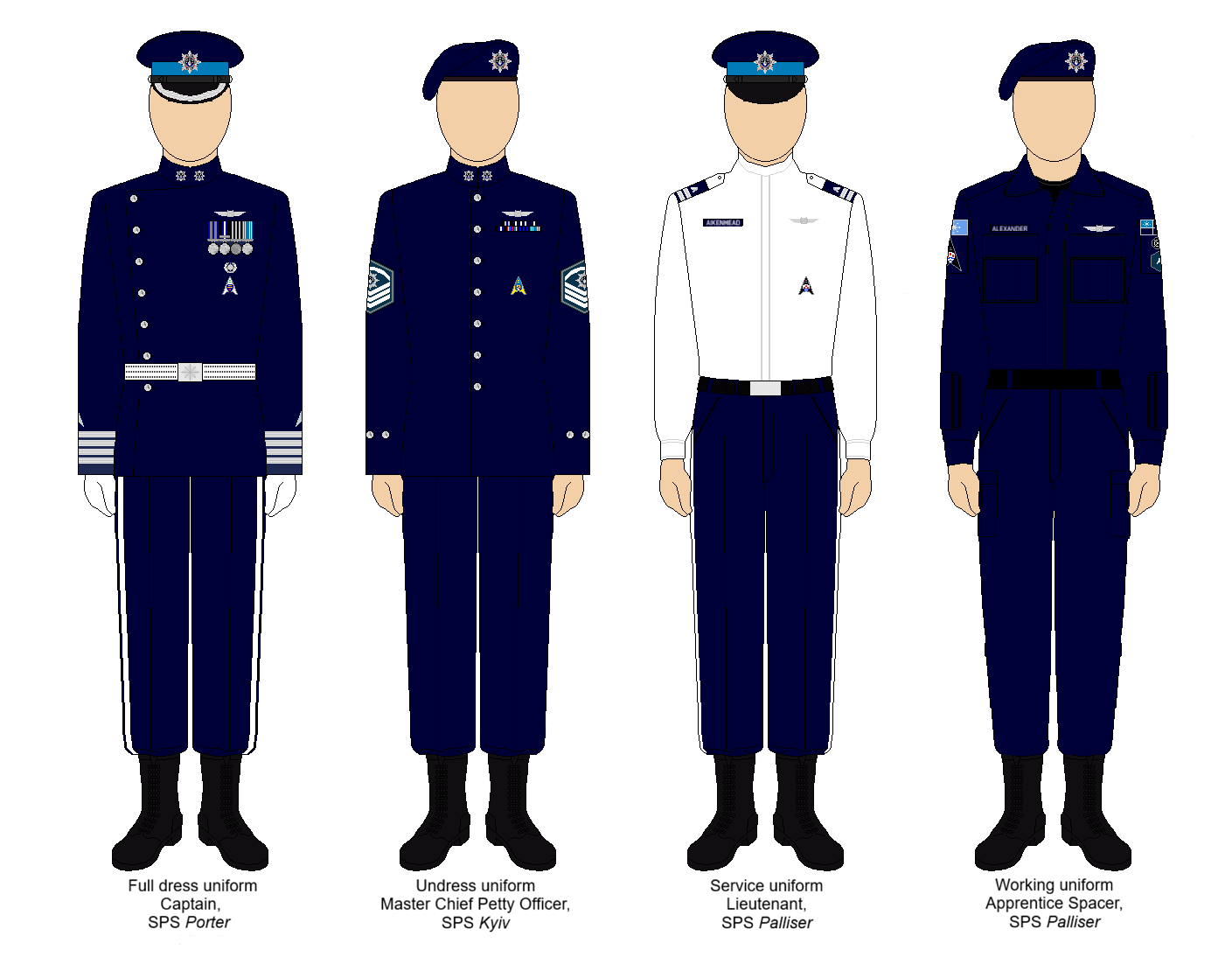
Uniforms of the Space Patrol Service. Original template by Tounushi.
Dress uniform
Space Patrol Service officers wear a dark blue (formally referred to as “spacer blue” in Patrol publications), stand collar jacket made from cloned wool. The jacket is closed with seven silver buttons on the right-hand side. Each button is marked with the Patrol’s delta emblem. Rank stripes are worn on the cuffs. Decorations are worn on the left breast, below the wearer’s branch badge. The ship or station badge is worn below the medals. Officers in command of ships, stations, or installations wear the Commander’s Insignia, a silver winged Union Star, above their unit’s badge. Officers wear a peaked cap with a spacer blue crown and a Union blue band. The Space Patrol Service’s badge is worn in the centre of the cap, with matching smaller badges on the collar. Commanders and above wear a single row of silver fretting on their cap visors; flag officers wear two rows. Officers wear silver lampasses on their trousers: junior officers wear a single stripe, while Captains wear two stripes. Flag officers are distinguished by twin double-thickness lampasses.
Ratings wear a seven-buttoned, stand collar spacer blue jacket with a conventional front closure. As on the officers’ jacket, Patrol badges are worn on the collar. Ratings wear identical branch badges to officers but are further distinguished by their trade specialisation badges, worn on the upper sleeves. Rank insignia is worn in hexagonal badges on the upper sleeve below the trade badge. Chief Petty Officers and above wear three silver, delta-marked buttons on the lower sleeve. Ratings replace the peaked cap with a spacer blue beret. Ratings’ trousers are unadorned.
For ceremonial occasions, both officers and ratings wear white gloves, white web belts with a silver buckle displaying the Union Star, and full medals. Officers may wear a sword on their belt. For non-ceremonial “undress” occasions, belts, gloves, and medals are removed, and only medal ribbons are worn.
Service uniform
The service uniform is worn in office environments, typically when not underway. The dress jacket is removed, and both officers and ratings wear a white Merino wool collarless shirt. Officers wear rank insignia on their epaulettes while ratings wear rank and trade specialisation badges on their shirtsleeves. Personnel deployed to surface installations in warm climates may roll the sleeves up. Branch badges are worn on the left breast of the shirt. A name badge is worn on the right breast while branch badges are worn on the left. The trousers are identical to the dress uniform. A blue crewneck pullover in the same shade as the trousers may be worn with the service uniform.
Working uniform
Worn aboard ships or stations, the working uniform is a zip-closed, spacer blue jumpsuit made of a flame- and tear-resistant aramid/Merino wool blend. The jumpsuit is belted at the waist, and has two chest pockets, zip-closed upper sleeve pockets, and thigh cargo pockets. Officers wear rank insignia on the shoulder straps, while ratings wear a single rank insignia badge on the left sleeve pocket patch, below their trade badge. Both officers and ratings wear a silver-and-blue Space Patrol Service patch on the right sleeve, and a Patrol ensign flag patch on the left.
Unit and branch badges are worn with all uniforms: the Patrol’s major commands and fleets use kite-shaped badges, ships and stations use deltas; surface installations use hexagons; and all other units, squadrons, and detachments use ellipses. Units are further distinguished by colour: Fleet Command units are silver, Support, Systems, and Personnel Command units are gold, Training Command units are light blue, medical units are scarlet, and intelligence units are black. Unit badges are worn on the lower left breast of dress and service uniforms, and on the right sleeve of working uniforms.
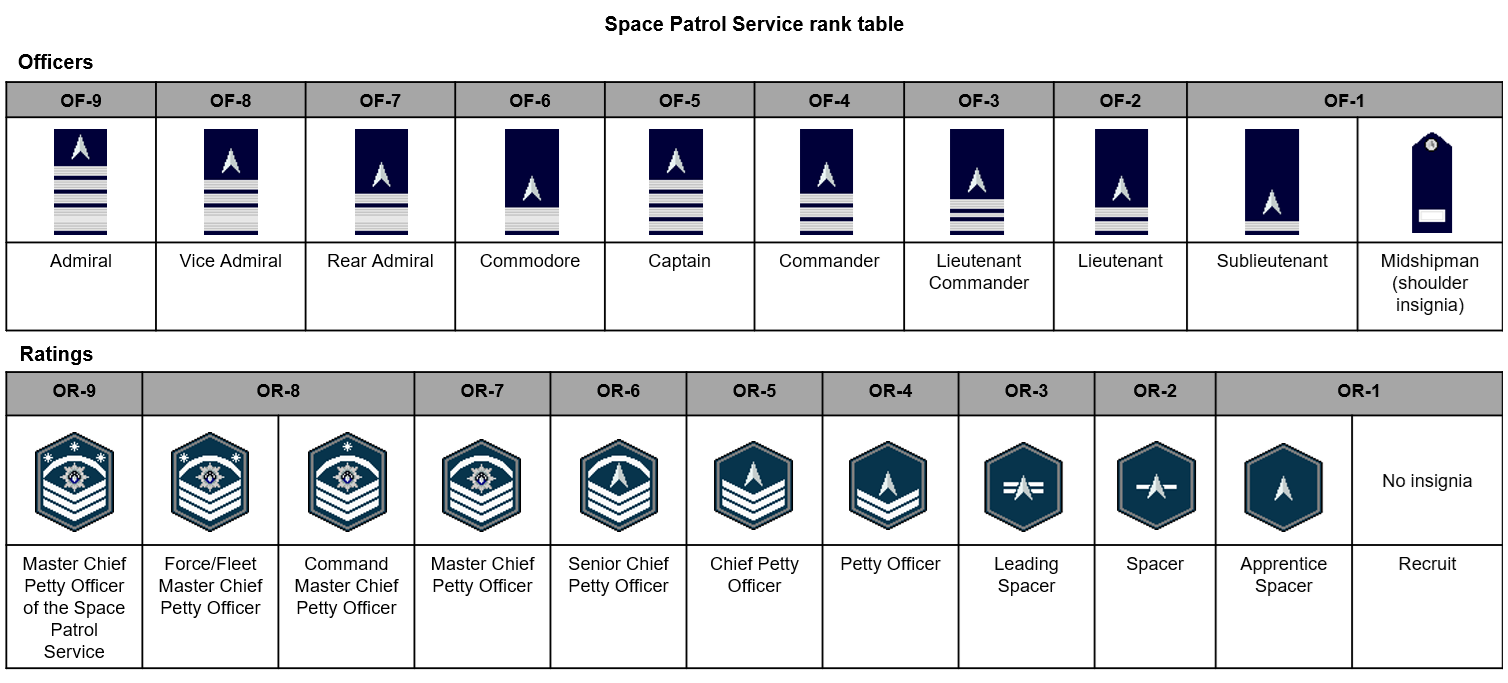
Branch badges are worn on the upper left breast of all uniforms: Operations personnel (including navigators, sensor operators, and weapon specialists) wear a silver winged globe with crossed missiles. Small craft personnel wear a silver winged delta. Administrative personnel (including suppliers, chefs, and clerks) wear a gold oak leaf sprig with a globe and two crossed quills. Medics wear a silver oak leaf sprig with a Rod of Asclepius. Engineers wear a silver Bohr atom flanked by lightning-bolt wings. Intelligence personnel wear a gloss-black lightning-bolt wings badge with the All-Seeing Eye emblem of the Patrol Intelligence Department. Patrol personnel attached to Deployable Operations Group units, such as medics, chaplains, and forward observers, wear a gunmetal-grey, winged Rifles, Globe, and Delta. In addition to rank and branch insignia, Space Patrol Service ratings wear circular trade badges (colloquially known as “tiffs”) to indicate their specific qualification and job. The trade badge is worn immediately above the rank insignia on all uniforms. The Patrol currently recognises some sixty trades.
Professionally Qualified Officers (PQOs) are further distinguished by unique insignia: legal officers wear a silver scales of justice badge over their rank insignia in place of the delta, while medical officers wear a wreathed Rod of Asclepius. Surgeons further wear scarlet “distinction cloth” between their rank stripes, nurses wear dull cherry, and dentists wear orange. Officers of the Patrol Construction Force, responsible for the design and building of surface installations and large-scale space stations, wear gold distinction cloths. Chaplains and celebrants wear no rank but are distinguished by a delta and open book insignia. Christian chaplains’ dress uniforms are modified to fit clerical collars.
Footwear for all uniforms is the Space Duty Boot. The Space Duty Boot is made of a graphene-impregnated polyurethane that resembles leather and can be polished to a high shine. A mounting bracket in the heel allows for the attachment of magnetic plates to secure the wearer to a deck. Patrol personnel are issued with two pairs of boots, one maintained as “best boots” for parades, the other kept for daily wear.